

The Questions That Move Us Forward
From engineering solutions for Ghana’s coastline to understanding productivity patterns of young professionals in Ghana, the Ashesi community continues to deepen its exploration into how research can advance learning and discovery.
Our strategic plan, Beyond the Horizon, emphasized research becoming a stronger part of what we contribute. Today, that ambition is raising a question of its own: what would allow more promising questions to become sustained research, useful knowledge, and meaningful applications?
Teaching machines to hear Twi, Fante and Ga
How much recorded speech does software need to work in a Ghanaian language, and does it matter what that speech is about?

Speech recognition systems learn from recorded, transcribed speech, but for most African languages, there are often no datasets available to learn from. Dennis Asamoah Owusu ’12, who teaches and conducts research on natural language processing at Ashesi, knew the gap from his own work: his startup, Nokwary Technologies, won the 2020 Ecobank Fintech Challenge with an AI banking assistant for people who do not speak English.
With Lacuna Fund support, he and David Sampah led an Ashesi team to build an open dataset in Asante Twi, Akuapem Twi, Fante and Ga. The team collected speech information from about 200 speakers per language, and recorded roughly 148 hours in all. The dataset was then released for public use, with a new set of questions: is the dataset enough for real services, and if not, what amount and kind of data is the most economical way to get there?
“With this dataset being available to the public, we hope to help developers build more applications for Africans, English-speaking or not.”
Dennis Asamoah Owusu, 2023
Dr. Elena Rosca teaching students in an Ashesi lab.
The research lab that grew from one student team
Can an engineered microbe detect a metal in the ground, or help hold a coastline together?
Questions like these run through Ashesi’s bioengineering research, which asks how biological systems can be engineered into low-cost, non-invasive sensors and treatments for use in Africa. Detecting gold in refractory ore is one of the problems researchers at Ashesi work on, and in 2017 it became the project of the university’s first team at iGEM, the international synthetic biology competition: an organism designed to sense, release and measure gold, as an alternative to the toxic extraction methods of small-scale mining.
“I was so impressed by how quickly our students, who had no background in molecular biology, were able to learn and apply the new knowledge,” shared Dr. Elena Rosca, who has coached Ashesi’s iGEM teams since 2017. “It was a strong example of effective learning, and seeing the student team’s success made me wonder how much more we could do in our labs and classrooms.”
Dr. Rosca subsequently helped build bioengineering courses, and in 2020, the year the first synthetic biology class began, she led a successful application for laboratory equipment from Seeding Labs. Student teams worked in that laboratory each year from 2022 to 2025, with Rosca as their faculty patron.
Swipe to see all five projects →
 2017
Gold in ore
An organism to sense, release and measure gold in ore.
The first Ashesi team Read more 2022
Gold in land
A biosensor to make gold prospecting less destructive.
Built on earlier Ashesi work Read more 2023
Lithium in soil
Bacteria that signal lithium levels in soil, and others to extract it.
Built on the 2022 project Read more 2024
Plastic and coastlines
A marine bacterium engineered to break down plastic and make bio-cement for sea defenses.
New organism, new problem. Watch the video. Read more 2025
Bio-cement with sensors
The same bacterium hardening sand into blocks with built-in pollution sensors.
Continued the 2024 work Read moreTheir projects form two lines of inquiry. The first three followed metals through soil, each explicitly building on the one before, from gold to lithium. In 2024 a team led by Rosca as principal investigator changed organism and problem, engineering a marine bacterium against Ghana’s coastal erosion, and the 2025 team continued in that direction. All five designs were developed at laboratory scale.
When Ashesi received accreditation for a Biological Engineering degree in 2025, the program drew on this teaching and research, but Rosca traces its origin to a different need. During COVID-19, vaccine makers looked to set up production in the region, and they would need engineers to support it.
Growing the infrastructure for research at Ashesi
In 2025, Ashesi established the Office of Research and Innovation, focused first on deepening support for various research initiatives and creating room for more to grow.
Dr. Yaw Bediako, Dean of Research and Innovation since November 2025, knows the pathway from research to use from the inside. An immunologist, he founded Yemaachi Biotech in 2020 to increase the representation of African data in cancer drug discovery, and he continues to lead the company. He has committed himself to research and development across Africa that links universities, industry, and national and regional institutions.

Bediako on why Africa must build its own vaccines, AI and medical research, in an episode of White Coat Diaries (47 minutes). Video: Willow Health Media
“I view research as a core liberal arts discipline that has the potential to become a powerful generative engine.”
Dr. Yaw Bediako, Dean of Research and InnovationNine faculty projects kickstart new research fellowship
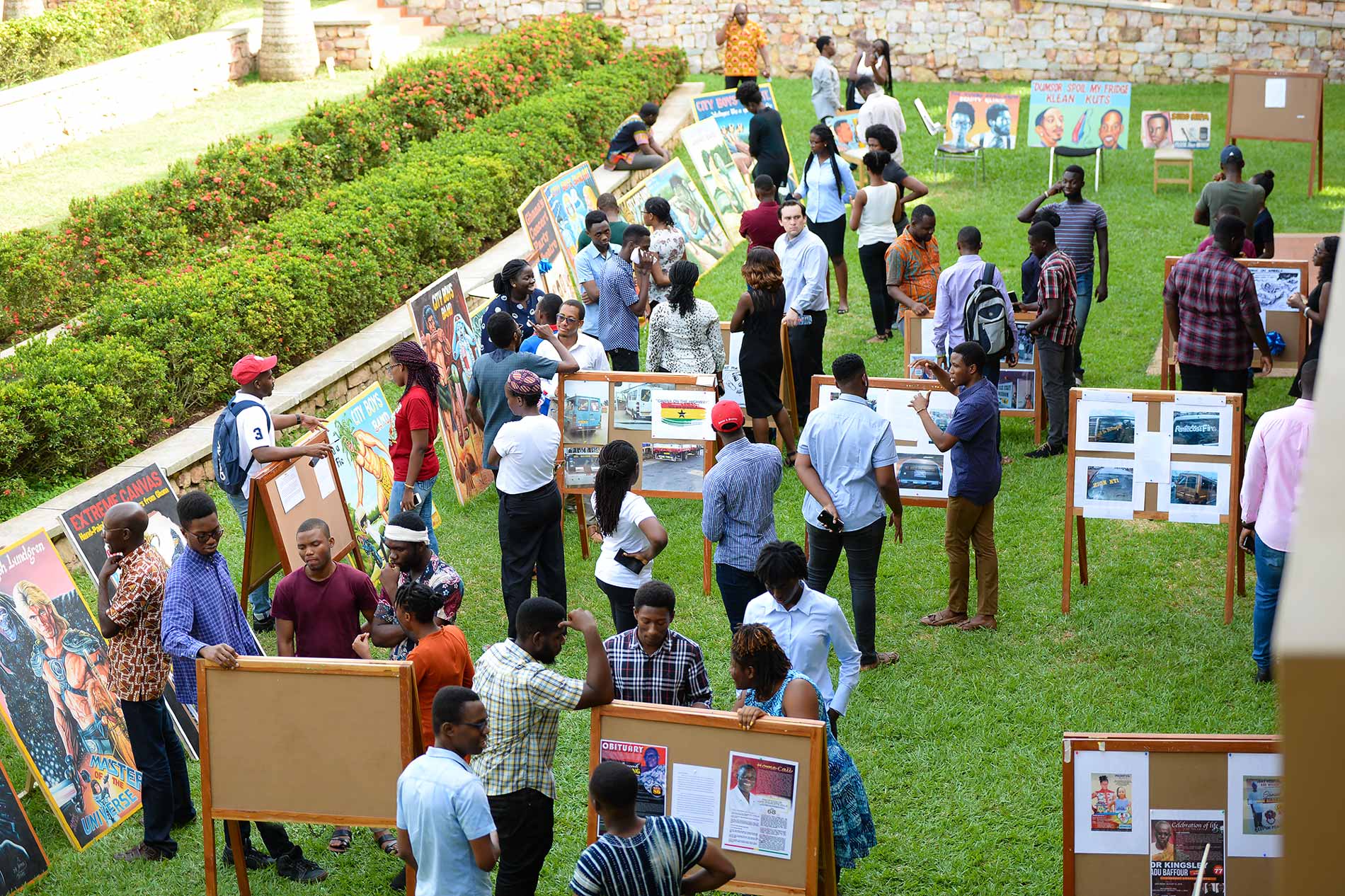
Launched in 2026, the Ashesi Program for Innovation, Research, and Entrepreneurship (ASPIRE!) organizes faculty work into six research clusters and offers seed funding and help with grant applications. Students can also find faculty mentors and submit capstone research through it.
Our inaugural ASPIRE! fellows, named in September 2026, bring a wide range of research questions. Economist Dr. Philip Kofi Adom, for example, working with Dr. Millicent Awuku, Klenam K. Sedegah and Dr. Hayford Mensah Ayerekwa, is asking how pay and workplace climate shape how young professionals divide their time between work and personal life, and how productive they are.
Their study, one of nine, is designed to pair employees’ accounts with independent assessments, test whether inclusive leadership, psychological safety and well-being help explain the link, and compare government and non-government workplaces. The team expects the evidence to inform labor and youth employment policy.
Eight more questions, from criminal law to agriculture
01
Can affordable evaporative cooling cut how much produce Accra’s vegetable traders lose to heat?
Gideon Ofori Osabutey02
Can a smartphone app reliably tell outreach teams which patients need cataract surgery?
Kwabena Bamfo03
What evidence would Ghana need to modernize its legal definition of rape?
Christine Opoku Onyinah04
Can AI explain, in plain language, why a mobile money message is a scam?
Kwadwo Gyamfi Osafo-Maafo, Dr. G. Ayorkor Korsah, Dr. Govindha Ramaiah Yeluripati05
Can exams stay fair on students’ own laptops without webcams watching them?
Dr. Ebo Adjepon-Yamoah06
Where does AI-assisted grading go wrong, and when must a person check it?
Sampson Asare, Dr. Govindha Ramaiah Yeluripati, Dr. Frank Acquaye07
How do Ghana’s agri-food businesses withstand and recover from shocks?
Dr. Disraeli Asante-Darko, Dr. Vivian Osei, Beauty Didia08
Why does interest in science not always become a science career, and does the answer differ for young women and men?
Dr. Heather BeemHow research helps students translate their learning into impact

Djan explains her research on surface water across sub-Saharan Africa at Carnegie Mellon’s Student Energy and Sustainability Research Symposium, March 2026. Photo: Scott Institute for Energy Innovation, Carnegie Mellon University
Nana Oye Djan ’19: from gold in ore to Africa’s surface water
Djan was one of the mechanical engineering students on Ashesi’s first iGEM team. Over six months the team learned biology, built some of their own equipment and worked on the gold-sensing organism, a project that took each of them outside the discipline they had come to study. In 2020 iGEM named her one of two ambassadors from Africa, helping new teams form across the continent. “IGEM encourages collaboration, and for me, this is key to building up the continent,” she said at the time.
Her doctoral research at Carnegie Mellon University today keeps the environmental and collaborative focus, but has changed the tools. Using remote-sensing data, she studies how inland surface water across sub-Saharan Africa is changing and how much of that change can be attributed to climate change, evidence meant to inform decisions about mitigation and adaptation.
Read her story
Benedict Quartey ’18.
Benedict Quartey ’18: from a model car to robots that learn
Quartey’s capstone began with a problem of cost: anyone who wanted to study autonomous vehicles needed equipment many could not afford. Working with Dr. Ayorkor Korsah, he built RollE, a low-cost, modular platform that collects driving data under remote control and then uses a neural network to drive itself. The two co-authored a paper presenting it as a tool for students and researchers with limited resources.
The project changed his career plan and eventually led him to a PhD program at Brown University. His doctoral research with George Konidaris and collaborators turned to a problem in robot learning: knowing how to perform several actions is not the same as knowing how to combine them when the goal changes. Primordiant, a company he co-founded that joined Y Combinator’s Fall 2026 batch, now draws on that line of work with robots meant to observe, propose explanations and run experiments.
Read his story
Darkwa speaking about ReFine, Mercy Corps’ refugee-finance program. Image: still from a video by Terre Nourricière
David Darkwa ’08: reaching the people a financial system leaves out
A financial service can work and still not meet the needs of the person using it. Darkwa met that problem in 2008, right after he graduated, at Microsoft Research India. As the second Ashesi student selected for the research internship, he wrote software for a study of mobile money-transfer designs for people with limited literacy. The researchers found that participants completed the tasks more successfully with a multimedia interface, while spoken dialogue was faster and needed less help.
A few years later he turned to a related barrier, leading the work behind software that lets people withdraw cash from an ATM without a bank card. Multiple banks across West Africa deployed it. Darkwa went on to further work around financial inclusion, spanning Guinea, Sierra Leone, Zambia, and Uganda.
Read his story“We shouldn’t wait for more graduate students; we need to empower undergraduates to start conducting this research now.”
Provost Angela Owusu-Ansah, speaking at the 2024 Quasar Awards Night
Guests at Ashesi’s 2026 Law Week.
Bringing broader perspectives into research at Ashesi

A new editorial home for Africa Today
A journal’s editors decide which research is reviewed and which reaches readers. For Africa Today, which has published peer-reviewed work on contemporary Africa and its diasporas since 1954, those decisions moved in February 2026 from Indiana University’s African Studies Program to Ashesi’s Humanities and Social Sciences department.
Dr. Hassan Wahab, who heads the department, is editor-in-chief, with law lecturer Prince Acquaye as managing editor. Wahab describes two obligations that come with the move: “Sustaining that tradition of rigorous scholarship remains central, while creating greater opportunities for our faculty and other scholars, particularly those based on the continent, to engage more directly in research and academic publishing.”
Read the storyStudying how we teach and how students learn
The Scholarship of Teaching and Learning (SoTL) conference, organized by the Office of the Provost, brings faculty from across the continent to campus each year to explore ideas and research on how to improve student understanding of what a course set out to teach. Participants, more than 100 in 2026, bring questions and evidence from their own classrooms, and share what they find.
“In research, a problem is an invitation to share new knowledge. But in teaching, a problem is often seen as an accusation.”
Professor Angela Owusu-Ansah, Provost
Participants in discussion at the 2025 SoTL Africa Conference at Ashesi.
One recent study treated a programming assignment as a SoTL problem. In an Ashesi data structures course, researchers from St. Olaf College and the University of British Columbia worked with Ashesi to have 130 second-year students explain their reasoning to an instructor-designed AI bot, aloud and in handwritten notes, before writing any code. Several students said the process helped them plan their solutions, and the researchers proposed that AI could be most useful in assessment when it complements the instructor.

A venue for legal scholarship on Africa
The Ashesi Law Journal gives scholars, practitioners and policymakers a peer-reviewed venue for work on contemporary legal questions and where law meets policy, aiming to inform governance and justice in Africa and beyond. Prof. Maame Mensa-Bonsu and Jonathan A. Alua edit it. After its inaugural edition, manuscripts received by December 19, 2026, will be considered for the next issue.
About the journal
How should law respond as Africa changes?
That question frames “Africa in Transition: Law, Policy and the Making of New Futures,” the Ashesi Law Colloquium 2027. Scholars, practitioners, judges, regulators and students will examine how African legal systems can adapt, across seven themes from constitutionalism to artificial intelligence and climate governance. It takes place at Ashesi on April 14 and 15, 2027; abstracts are due November 27, 2026.
Call for papersMoving research from prototype to consumers
A patient on oxygen still needs supply to flow even when the power fails. Agasha Faith Anne Maria and her team at PearlOxy Uganda Limited are developing a system that stores oxygen while the electricity is on and supplies patients automatically when it goes off.
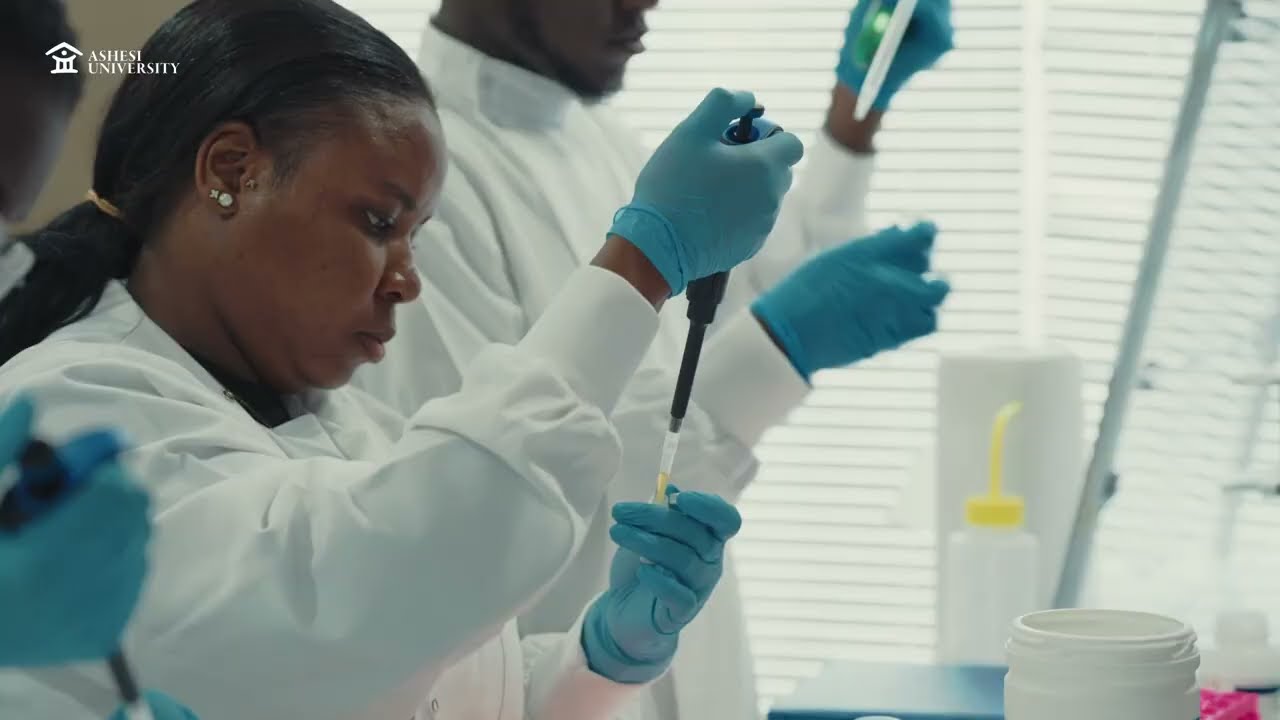
Building Africa’s next generation of biotech innovators: the bootcamp and its partners (2:31).
Designing the system is one problem; getting it into the facilities that need it raises others, in regulation, product testing and adoption. Those are the subjects of the first Translational Research & Innovation Bootcamp, which selected Agasha and 34 other innovators from nine African countries working in health, biotechnology and biomanufacturing.
Ashesi will run it from November 2 to 6, 2026, with the African Institute of Biomedical Science and Technology and Yemaachi Biotech.
What keeps good questions going
A research project often leaves more than its findings. It can leave a foundation for another team, a method that students learn to apply, or a question that a colleague then takes further. Making room for that next investigation is part of the research environment Ashesi is building.
Through the Office of Research and Innovation, faculty can seek seed funding, get help with grant applications, and request research interns to assist with tasks such as literature searches and data collection. Funding opportunities for full-time faculty also include support for sharing their work in public spaces. These resources help researchers develop an idea, carry out the investigation, and bring it into conversation with others.
The work draws on resources beyond the research office. The Warren Library provides access to scholarly databases and subject guides for each academic department, alongside help with literature searches, research consultations, and citation management with Zotero. Its institutional repository, which holds faculty research papers, open-access articles, and undergraduate theses and applied projects, gives research produced at Ashesi a place where others can find it and build on it.
Bring a question.
Every investigation here began with someone who wanted an answer. Whether you are at Ashesi or thinking of joining us, the Office of Research and Innovation can help you see where a question might fit.